BIAFRA : Remembering Nigeria's Biafra war that many prefer to forget

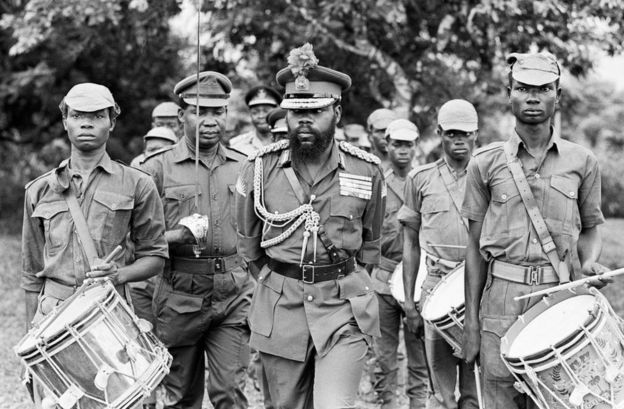
Colonel Odumegwu Ojukwu, the Military Governor of Biafra in Nigeria inspecting some of his troops, 11th June 1968.
The deaths of more than a million people in Nigeria as a result of the brutal civil war which ended exactly 50 years ago are a scar in the nation's history.
For most Nigerians, the war over the breakaway state of Biafra is generally regarded as an unfortunate episode best forgotten, but for the Igbo people who fought for secession, it remains a life-defining event.
In 1967, following two coups and turmoil which led to about a million Igbos returning to the south-east of Nigeria, the Republic of Biafra seceded with 33-year-old military officer Emeka Odumegwu Ojukwu at the helm.
The Nigerian government declared war and after 30 months of fighting, Biafra surrendered. On 15 January 1970, the conflict officially ended.
The government's policy of "no victor, no vanquished" may have led to a lack of official reflection, but many Nigerians of Igbo origin grew up on stories from people who lived through the war.


Three of those who were involved in the secessionist campaign have been sharing their memories.
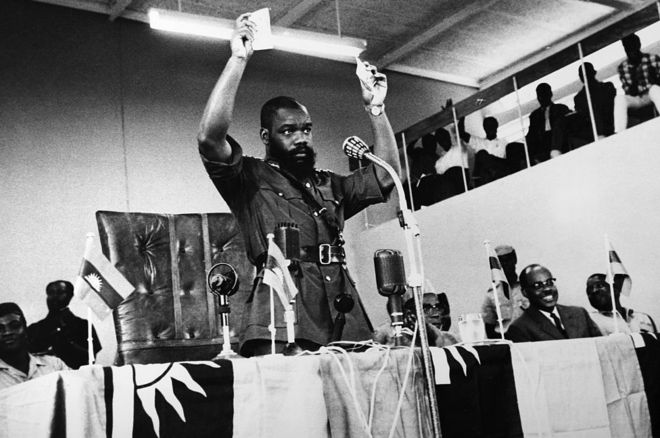
Lieutenant Colonel Okumegwu Ojukwu Eastern Nigeria's military Governor and chief of secessionist state of Biafra on war against the federal state of Nigeria, addressing a speech to Biafra parliament on July 16, 1967 in Biafra, Nigeria.

We thought we were magicians'

Christopher Ejike Ago, soldier
He had just finished grammar school and started training as a veterinary assistant at the University of Nigeria, Nsukka (UNN), in south-eastern Nigeria, when the civil war began.
Almost every student he knew became part of the war effort.
He joined the Biafran army and was assigned to the signal unit, whose responsibilities included "active intelligence and eavesdropping on the Nigerian military".
The Nigerians who were pursuing us were trained soldiers... We were drafted into the war, given two days' training."
Christopher Ejike Ago
Soldier in the Biafran war
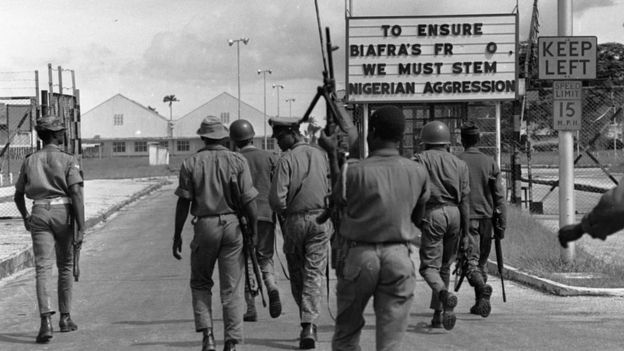
Nigerian troops entering Port Harcourt, after routing Biafran troops during the Biafran War.Presentational white space
"We thought we were magicians," said 76-year-old Mr Ago.
"The Nigerians who were pursuing us were trained soldiers. We were not. We were drafted into the war, given two days' training.
"Plus the fact that we were hungry. Some of us, our skin was getting rotten. Nobody can fight a war like that."
In January 1966, some senior Nigerian army officers, mostly of the Igbo ethnic group, assassinated key politicians during a coup in the West African state.
Those killed included Ahmadu Bello, a revered leader in the north.

This led to months of massacres against the Igbo living in the north. Tens of thousands were killed while about a million fled to what was then known as the Eastern Region.
These events sparked the Igbo's decision to secede, spearheaded by Ojukwu, who was then the military governor of the Eastern Region.
In the months preceding the war, Ojukwu often visited UNN, the only university in south-eastern Nigeria at the time, to meet with students and prepare them for secession.
Mr Ago looked forward to these visits, and joined the crowd who gathered at the university's Freedom Square.
"Once his helicopter touched down, everybody went there and, practically, school shut down.
"He had this incredible sense of humour. He spiked everybody up and we formed songs and were singing and enjoying ourselves."
In the first year of the war, the Nigerian government captured the coastal city of Port Harcourt and imposed a blockade, which cut food supplies to Biafra.
Mr Ago remembers the overpowering hunger that often forced Biafran soldiers to catch and eat mice. He also remembers the last year of the war when his unit was continuously on the move, fleeing the advancing Nigerian army.
"Somewhere in the middle of the war," he said, "the Biafrans made some dramatic successes that gave us hope that we might hold the Nigerians until at least some help from outside came."
By late 1969, all hope was lost.

Comments

Popular posts from this blog

Nnamdi Kanu Sends Important Message To IPOB Members From Detention

    The detained leader of the proscribed Indigenous People of Biafra (IPOB), Mazi Nnamdi Kanu, has sent an important message to his followers over the Biafra movement. The embattled separatist according to one of his brothers, Prince Kanu Meme, has asked his disciples to trust and comply with directives from the Directorate of State (DOS). Boasting his belief in the separatist movement’s administrative structure, Kanu said “I’m DOS and DOS is me”.  Naija News understands that the DOS, headed by diaspora-based Chika Edoziem has been contending with authority issues since Kanu’s arrest in Kenya in June 2021. It has been observed that IPOB is in disintegration following Nnamdi Kanu’s rearrest and detention. The present situation of the Biafran movement can be likened to that of sheep without a shepherd. However, Kanu in a conversation with his sib...

IPOB: The Nigerian Civil War, commonly known as the Biafran War

  THE HISTORY OF BIAFRA AND NIGERIA WAR  Israel, Nigeria and the Biafra civil war    The Nigerian Civil War , commonly known as the Biafran War (6 July 1967 – 15 January 1970), was a war fought between the government of Nigeria and the secessionist state of Biafra. Biafra represented nationalist aspirations of the Igbo people, whose leadership felt they could no longer coexist with the Northern-dominated federal government. The conflict resulted from political, economic, ethnic, cultural and religious tensions which preceded Britain's formal decolonization of Nigeria from 1960 to 1963. Immediate causes of the war in 1966 included a military coup, a counter-coup and persecution of Igbo living in Northern Nigeria. Control over the lucrative oil production in the Niger Delta played a vital strategic role. Within a year, the Federal Government troops surrounded Biafra, capturing coastal oil facilities and the city of Port Harcourt. The blockade imp...

Judge transfers Nnamdi Kanu’s motion to CJ for reassignment

Judge transfers Nnamdi Kanu’s motion to CJ   on   September 15, 2025 By   Matthew Atungwu   Justice   Musa Liman of the Federal High Court in Abuja, on Monday, sent back to the Chief Judge, CJ, a motion filed by Nnamdi Kanu,  leader of the proscribed Indigenous People of Biafra, IPOB, for reassignment.      Make money online with cheelee Kanu, in the motion ex-parte, is seeking an order of the court transferring him to Abuja National Hospital for urgent medical attention. Justice Liman, in a short ruling, made the order transferring the case file back to the CJ, following an application by Kanu’s counsel, Uchenna Njoku, SAN, considering the fact that the annual vacation of the court would be ending The Department of State Services (DSS) lawyer, Chief Adegboyega Awomolo, SAN, did not oppose Uchenna’s application. Earlier, upon resumed hearing in the case, the judge hinted that there was no time anymore for the vacation court to decide Ka...
